PROCESS SEQUENCE
Base-oil receiving and segregation, heated transfer, gravimetric or mass-flow dosing, additive preparation, controlled blending, recirculation or in-line homogenization, quality sampling, polishing filtration, finished-product storage and filling.
MAIN EQUIPMENT
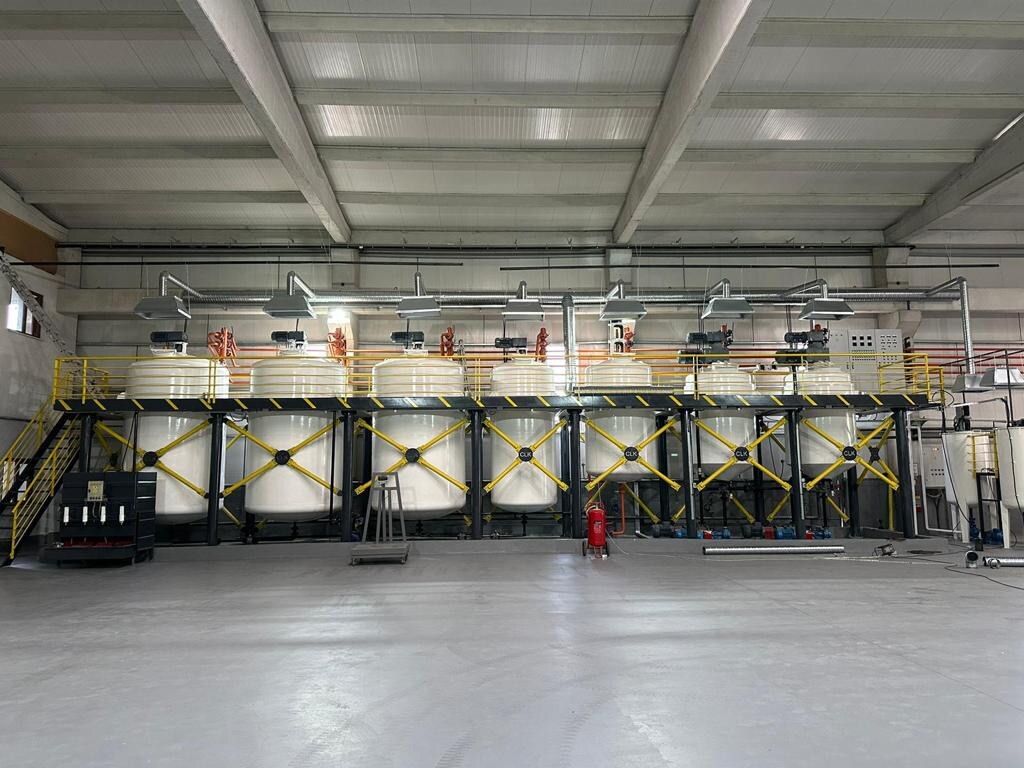
Base-oil tanks, additive day tanks, heated blend vessels with agitators and load cells, transfer and recirculation pumps, strainers, polishing filters, manifolds, finished-oil tanks, piggable or dedicated lines and optional drum/IBC/package filling systems.
PRODUCT RANGE
Engine oils, gear oils, hydraulic fluids, transmission fluids and general industrial lubricants may be produced where the approved formulation, base-stock compatibility and additive supplier requirements are met. Grease production requires a separate process package.
OPERATING ENVELOPE
Typical blending temperature is approximately 45–70°C, adjusted for product viscosity and additive stability. Filtration commonly ranges from 5–25 μm. Final values are confirmed by product formulation and required quality release criteria.
AUTOMATION & TRACEABILITY
PLC/SCADA batch control, recipe authorization, barcode or lot tracking, automated valve sequencing, mass-balance verification, alarm/event history and batch reports. Manual, semi-automatic and fully automatic operating modes are available.
QUALITY CONTROL
Sampling points and laboratory interfaces support viscosity, density, flash point, pour point, water, TBN/TAN and appearance checks as applicable. Product release remains subject to the customer formulation and applicable brand or market specification.
SAFETY & ENVIRONMENT
Secondary containment, overfill protection, bonding and earthing, temperature and high-high-level trips, closed drains, ventilation, spill collection, hot-surface protection and fire-system interfaces are coordinated with the product flash points and local hazardous-area assessment.
TURNKEY DELIVERY SCOPE
Design Basis, mass and utility balance, PFD, P&ID, equipment and instrument datasheets, 3D layout, civil and structural interfaces, fabrication, inspection, FAT, shipment, installation supervision, commissioning, operator training and performance verification.
DESIGN & CODE BASISAPI 650/620 for applicable storage duties, ASME VIII or EN 13445 for pressure vessels, ASME B31.3 or EN piping standards, IEC/ATEX hazardous-area requirements, NFPA/local fire codes and the destination-country regulatory basis. Applicable codes are finalized during Design Basis approval.